How Many Subjects Does IGCSE Have?
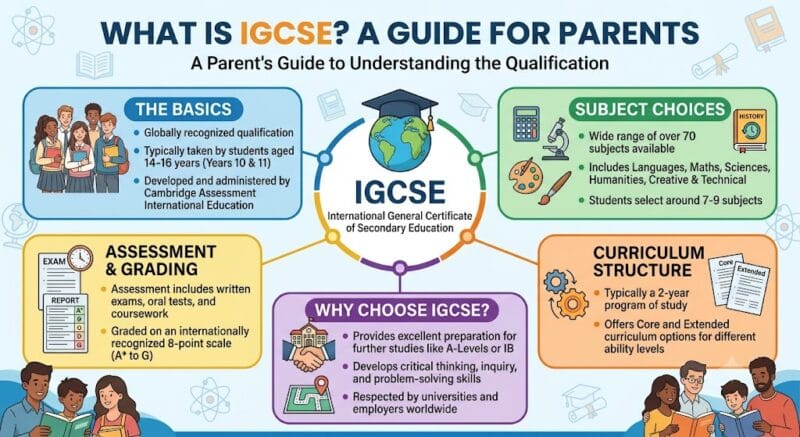
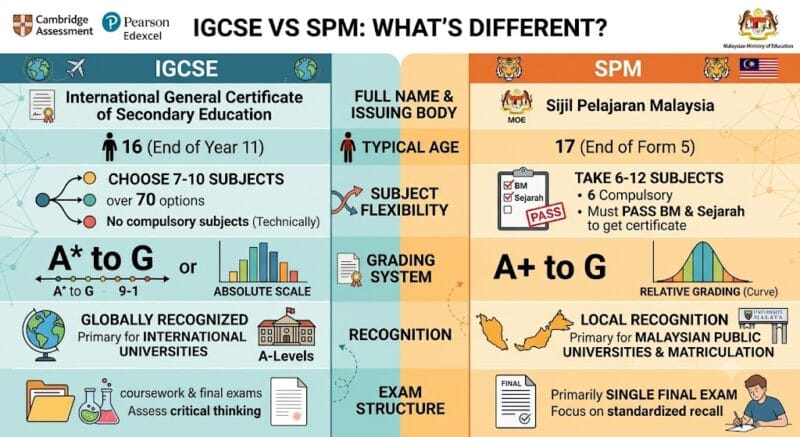
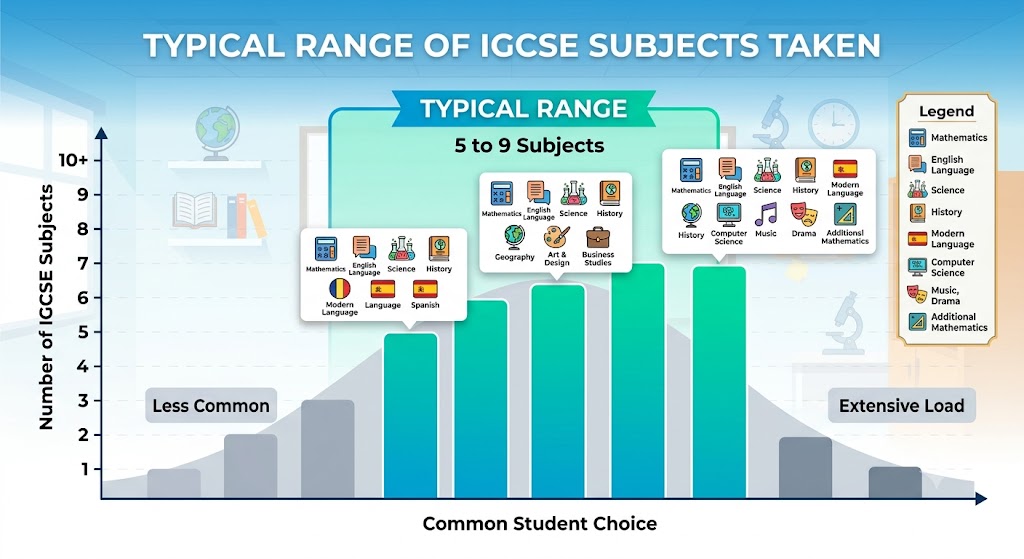
There’s no single fixed number every IGCSE student takes — the qualification itself offers more than 70 subjects to choose from, but individual schools set their own minimum, most commonly somewhere between five and nine subjects. There’s also no universal Cambridge-wide requirement; the actual number always comes down to the specific school’s policy.
For Malaysian parents comparing schools, this is a genuinely useful question to ask directly, since it varies more than families often expect — see Aura Tycoon’s parent guidance for more questions worth raising during school visits. Once the subject count is settled, understanding how those results will actually be graded is usually the next practical question.
How Many IGCSE Subjects Are Available in Total?
Cambridge alone offers more than 70 subjects, including around 30 languages, which schools can combine in almost any arrangement, according to Cambridge International’s own IGCSE subject listing. Pearson Edexcel and Oxford AQA offer their own, separately sized subject lists, though with significant overlap in the core areas most students study.
How Many Subjects Do Most Students Actually Take?
Most schools set a practical range, typically:
- 5–6 subjects — a common minimum requirement at many schools
- 7–8 subjects — the range most students land in
- 9 or more — taken by some students aiming at highly competitive university courses
There’s no evidence that taking more subjects automatically improves university outcomes — strong grades in a focused set of relevant subjects generally matter more than sheer subject count.
Are Any Subjects Compulsory at IGCSE?
Not through Cambridge itself, but individual schools almost always require a core group — typically English, Mathematics, and at least one Science — as a school-level policy rather than a Cambridge-wide rule. Beyond that core, most schools allow genuine choice based on student interest and future plans.
How Should a Family Decide How Many Subjects to Take?
The right number depends on the student’s workload capacity and the specific requirements of universities or A Level courses being targeted, rather than a fixed ideal number. Taking on more subjects than a student can realistically revise well tends to produce weaker overall results than a smaller, well-prepared set — quality of preparation matters more than raw subject count.
Free practice tool
Aura Tycoon is a free learning platform for Cambridge-track students — each chapter combines teaching videos, quizzes, and flashcards with practice questions, all with no ads and no cost. It builds the Science foundation early — free Year 7 Biology, Chemistry and Physics practice with mistakes tracked by topic, well before subject-count decisions need to be made.
Start Practicing FreeFrequently Asked Questions About IGCSE Subject Numbers
Is there a Cambridge-wide minimum number of IGCSE subjects?
No, Cambridge itself doesn't set a universal minimum — individual schools decide their own required subject count, most commonly between five and nine. This varies meaningfully between schools, so it's worth asking directly.
Does taking more IGCSE subjects improve university chances?
Not automatically — universities generally care more about strong grades in relevant subjects than about a high total subject count. Overloading on subjects can sometimes weaken overall results if revision time gets spread too thin.
Are English, Maths and Science always compulsory at IGCSE?
Not through Cambridge itself, but the vast majority of schools require this core group as their own policy. Requirements should be confirmed directly with the specific school, since Cambridge doesn't mandate it centrally.
Can a student take fewer than five IGCSE subjects?
It's technically possible depending on school policy, though most schools set five or six as a practical minimum to meet typical university entry expectations. Very few subjects can limit progression options later.
Is there a maximum number of IGCSE subjects a student can take?
There's no strict Cambridge-wide maximum, though schools have practical limits based on timetabling and workload. Extremely high subject counts are uncommon and not generally necessary for strong university applications.
Do Science subjects count as one or three toward the total?
This depends on whether a student takes Combined Science (one certificate, counted differently) or separate Biology, Chemistry and Physics (three individual subjects). Schools can usually clarify how this affects a student's total count.
How do Malaysian Cambridge schools typically set subject requirements?
Requirements vary school by school, though many Malaysian Cambridge-curriculum schools set a core of five to eight subjects including English, Mathematics and Science. Contacting the specific school is the most reliable way to confirm.
Should subject choice be based on interest or future career plans?
Ideally both — subjects a student is genuinely interested in tend to be revised more effectively, while keeping an eye on likely A Level or university requirements avoids closing off future options. A short conversation with a school counsellor can help balance the two.