
How to Know If Your School Offers Double or Triple Science
The most reliable way to know whether a school offers Double Award (Co-ordinated) Science or Triple (Separate) Sciences is to ask directly — school subject handbooks, the academic office, or a Year 9 subject-choice briefing will confirm exactly what’s on offer, since availability varies significantly between schools and isn’t something to assume. Some schools offer all three options (Combined, Double Award, Separate), while others limit choice based on staffing or timetabling.
For Malaysian families approaching this decision, it’s worth pairing this practical question with the broader Combined vs Separate Sciences comparison, so the “what’s available” question and the “what’s right for us” question get answered together. Aura Tycoon’s guidance for parents covers more of these school-comparison questions too.

What Questions Should Parents Ask the School Directly?
Since Combined Science, Co-ordinated Science, and Separate Sciences are genuinely distinct qualifications and not just different names for the same thing, according to Cambridge International’s own guidance on the distinction, it’s worth asking precisely rather than assuming. A few specific questions get the clearest answers:
- “Which Science combinations do you offer — Combined, Co-ordinated, and Separate?”
- “Is there a minimum academic requirement to be placed in Separate Sciences?”
- “Which exam board do you use for Science, and which specific syllabus code?”
- “Can a student switch between combinations after Year 9, and how late?”
Getting clear answers to these before subject choices are finalised avoids assumptions that turn out to be wrong.
Where Else Can This Information Be Found?
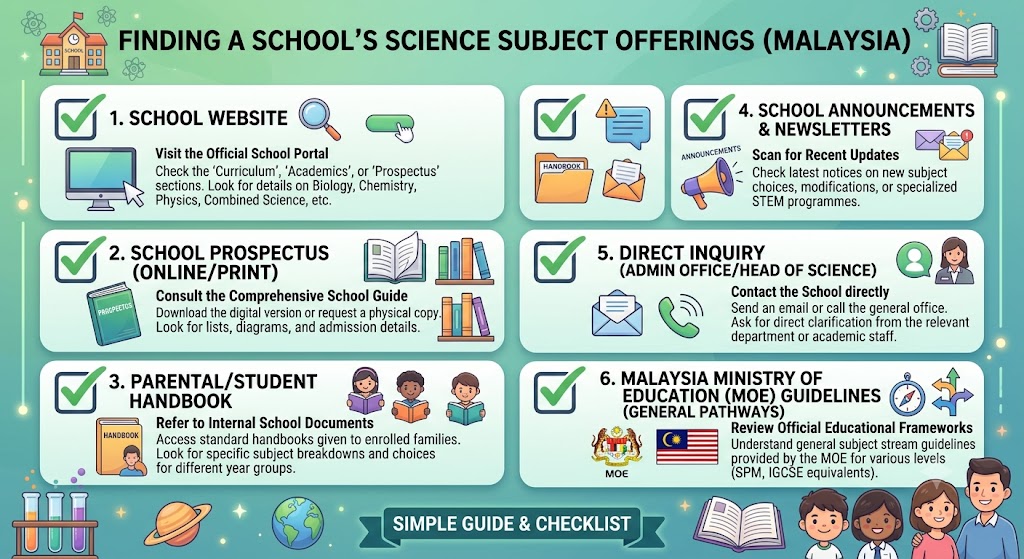
Beyond asking directly, school subject-choice handbooks (often distributed before Year 9 subject selection), the school’s own website under academic or curriculum sections, and Year 9 parent information evenings are the most common sources. If none of these clearly answer the question, a direct email or meeting with the academic office or Head of Science is the most reliable next step.
Do Schools Ever Base Placement on Academic Performance?
Yes — some schools require students to meet a minimum performance bar, often based on Year 8 or Year 9 assessment results, before being placed into Separate Sciences rather than Combined or Co-ordinated Science. This is worth asking about specifically, since it means the choice may not be entirely up to the family if the school operates this way.
What If a School Doesn’t Offer the Combination a Family Wants?
If a school’s offering doesn’t match a family’s goals — for example, a school only offering Combined Science when Separate Sciences is genuinely needed for a target pathway — options include registering the missing subjects privately, discussing flexibility with the school directly, or, in some cases, considering whether a different school better matches the family’s academic plans.
Free practice tool
Aura Tycoon is a completely free, ad-free learning platform for Cambridge-track students, with chapter videos, quizzes, flashcards, and practice questions built into every topic. It supports the Year 7 Biology, Chemistry and Physics foundation for free, well before this decision needs to be made.
Start Practicing FreeFrequently Asked Questions About Finding Out School Science Options
What's the fastest way to find out what Science options a school offers?
Asking the school's academic office or checking the Year 9 subject-choice handbook directly is usually the fastest, most reliable route. School websites sometimes list this too, but confirming directly avoids outdated information.
Do all schools let students choose freely between Combined and Separate Sciences?
No, some schools set academic performance requirements for entry into Separate Sciences, meaning the choice isn't always entirely open to every student. Asking about this specifically avoids assuming free choice where it may not exist.
Can a family switch schools if their current school doesn't offer the right Science combination?
This is a genuine option some families consider, though it's a significant decision that should weigh many factors beyond just Science subject availability. Discussing flexibility with the current school is usually worth trying first.
Is it common for schools to offer all three Science combination options?
It varies considerably — some schools offer Combined, Co-ordinated, and Separate Sciences, while others may only offer one or two due to staffing or timetabling constraints. There's no universal standard, so checking directly is essential.
When do schools typically announce their Science subject options?
This usually happens ahead of Year 9 subject selection, often through a parent information evening, handbook, or direct communication from the school. Timing can vary, so asking early avoids missing the relevant announcement.
Should a family ask about exam board as well as Science combination?
Yes, since Cambridge, Edexcel, and Oxford AQA structure their Science options slightly differently, knowing both the combination and the exam board gives a complete picture of what a student will actually study.
What if a school changes its Science offering after a family has already chosen it?
This is uncommon but not impossible, particularly if staffing changes. If it happens, raising immediate concerns with the school and asking about transition support or alternatives is the appropriate next step.
Is it worth asking about switching flexibility even before choosing a combination?
Yes, understanding how late a switch can happen, and what catching up would involve, is useful context even if a family doesn't expect to need it. It reduces risk if plans or performance change unexpectedly later.