What Is Active Recall?
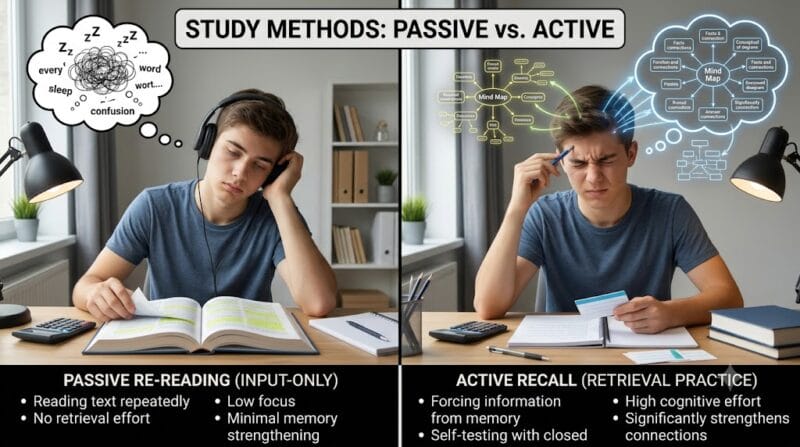
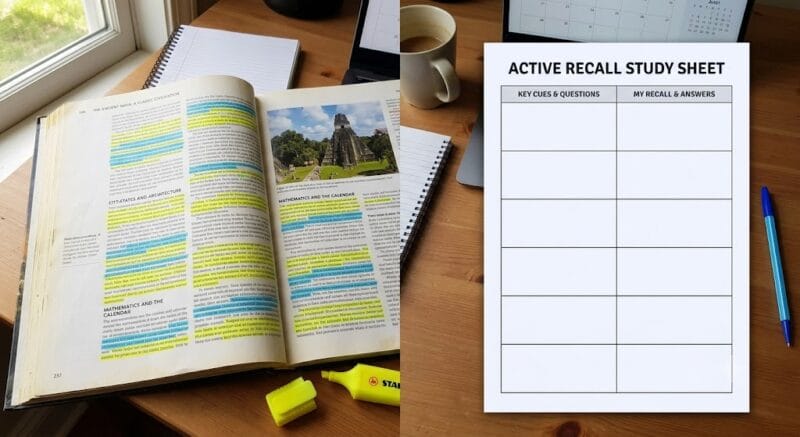
Active recall is a revision technique where you deliberately retrieve information from memory — writing out what you remember, answering a question, or explaining a concept without looking — instead of re-reading or highlighting notes. Pulling an answer out of your memory is what strengthens it; passively reviewing notes mostly builds a false sense of knowing.
It’s one of the highest-return habits a Cambridge or IGCSE-track student can build, and it costs nothing but a slightly harder study session. It also pairs naturally with anything that shows you what to recall — for example a running record of the exact questions you’ve already gotten wrong, like Aura Tycoon’s automatic Weakness Log that tracks mistakes by topic, so retrieval practice targets real gaps instead of whatever’s easiest to remember.

Why Does Active Recall Work Better Than Re-Reading?
Active recall works because the effort of retrieving a memory strengthens it, whereas re-reading mainly builds familiarity that feels like knowledge but collapses under exam pressure. When you re-read a page several times it starts to feel easy — but that ease is recognition, not recall, and in the exam hall there is no page to recognise, only a blank space to fill.
Decades of memory research, including studies with school-age children, find that students who test themselves on material remember substantially more later than students who simply reread it, according to peer-reviewed research on retrieval practice in children. Within reason, the harder a retrieval feels, the more durable the memory it builds — which is why active recall can feel less pleasant than re-reading while working far better.
How Do You Actually Use Active Recall?
The simplest way to start is to close your notes, write down everything you can remember about a topic, then open them and mark what you missed. A few reliable methods:
- Blank-page brain dump — write everything you know about a topic from memory, then check and fill the gaps.
- Flashcards — question on the front, answer on the back; say or write the answer before flipping.
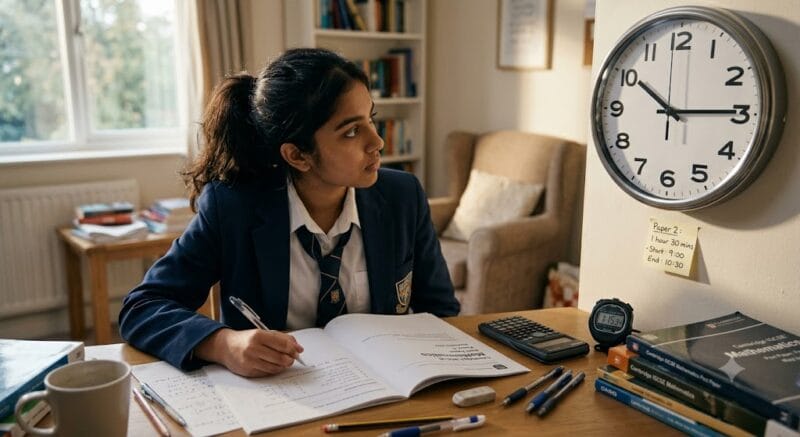
- Past-paper and practice questions — attempt each one closed-book first, before checking the mark scheme.
- Explain it aloud — teach the topic to an empty room, a sibling, or a parent without reading from notes.
The common thread is that your notes stay closed while you produce the answer. If your notes are open, you’re reviewing — not recalling.

How Is Active Recall Different From Spaced Repetition?
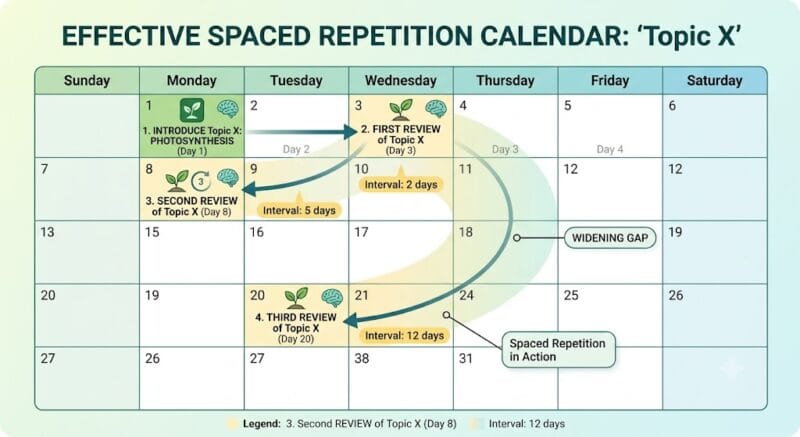
Active recall is how you revise — retrieving from memory; spaced repetition is when you revise — returning to material over gradually widening gaps. They are strongest together: you use active recall in each session, and spaced repetition decides how often a given topic comes back around. A topic you keep getting right can be revisited less often; one you keep missing needs shorter gaps. For the timing side in full, see how spaced repetition schedules your revision over time.
How Can Cambridge-Track Students in Malaysia Start Tonight?
Pick one topic from today’s lesson, close the book, and write down everything you remember about it — that single habit, repeated, is active recall. Malaysian students on the Cambridge Lower Secondary and IGCSE pathway can fold this into revision they already do: turn each past-paper question into a closed-book attempt first, and keep a short list of what you couldn’t recall to revisit in a few days. Across a full exam series — whether the May/June or October/November sitting — those revisit lists become a precise map of what still needs work.
Free practice tool
Aura Tycoon is a free, ad-free platform built for Cambridge-track students, where every chapter bundles short videos, quizzes, and flashcards together with practice questions and quick games. It lets Year 7 students practise Biology, Chemistry and Physics for free, logging every wrong answer by topic so active recall always has a clear target — no manual tracking required.
Start Practicing FreeFrequently Asked Questions About Active Recall
Is active recall better than re-reading notes for IGCSE revision?
Yes — for most students active recall produces stronger long-term memory than re-reading, because retrieving information strengthens it more than reviewing does. Re-reading still helps for a first pass through new material, but it shouldn't be the main method close to an exam.
How much time should I spend on active recall?
There's no fixed number, but even 15–20 minutes of closed-book retrieval is usually more effective than an hour of passive re-reading. Quality of effort matters more than total time, so shorter, harder sessions beat long comfortable ones.
Does active recall work for Science subjects like Biology and Chemistry?
Yes, active recall works well across Science, including definitions, processes, and problem-solving steps. For topics with diagrams or sequences, try redrawing or re-listing them from memory before checking the original.
Is active recall the same as memorising?
Not quite — memorising usually means repeating information until it sticks, while active recall means retrieving it without prompts, which also strengthens understanding of how ideas connect. Active recall tends to expose gaps that rote repetition hides.
Does active recall help with Cambridge Checkpoint as well as IGCSE?
Yes, active recall suits Checkpoint too, since Checkpoint tests accumulated knowledge across Years 7–9 rather than a single term's content. Regularly recalling older topics keeps them accessible for the Year 9 papers.
What's the easiest way to start active recall as a beginner?
The easiest start is the blank-page method: close your notes, write everything you remember about one topic, then check what you missed. It needs no special tools and works from the very first session.
How often should I use active recall before an exam?
Ideally in short sessions spread across the weeks before an exam rather than crammed into the final days, revisiting weaker topics more frequently. Combining active recall with spaced timing is more effective than either method alone.
Can Year 7 students use active recall, or is it only for exam years?
Year 7 students can absolutely use active recall, and starting early builds the habit before the stakes rise. The same closed-book retrieval that helps in the IGCSE years works just as well for Lower Secondary topics.