The Feynman Technique Explained
The Feynman Technique is a study method where you explain a topic in plain, simple language as if teaching a beginner — then go back and fix whatever you couldn’t explain clearly. The gaps you hit while explaining reveal exactly what you don’t truly understand yet.
For Cambridge and IGCSE-track students in Malaysia, it’s a fast way to tell the difference between recognising a topic and actually understanding it. Because it exposes weak points so clearly, it works well alongside a Weakness Log that records mistakes by subject and chapter, giving you a running list of what to re-explain.
How Does the Feynman Technique Work?
It runs in four steps:
- Pick a concept and write its name at the top of a page.
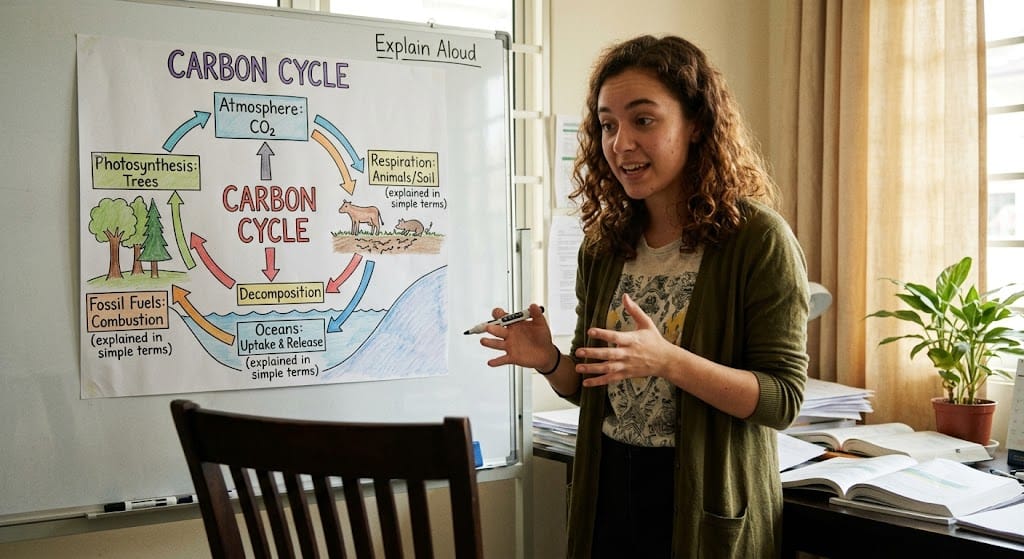
- Explain it simply, in your own words, as if teaching someone with no background — out loud or in writing.
- Spot the gaps — the moments you get stuck, go vague, or fall back on jargon show what you don’t really understand.
- Return to the source, then simplify again — relearn the weak part and re-explain it plainly.
You repeat until the whole explanation is clear and jargon-free.
Why Does Explaining Something Reveal What You Don’t Know?
Explaining a topic in your own simple words forces you to connect ideas rather than just recognise them, which is why gaps surface so quickly. Putting an idea into plain language is a form of self-explanation, a technique cognitive and educational psychologists have found supports deeper understanding in their review of effective learning techniques. Copying a definition can hide confusion; explaining it simply cannot.
How Is the Feynman Technique Related to Active Recall?
The Feynman Technique is a form of active recall, because explaining a topic without looking means retrieving it from memory first. The difference is that it also tests whether you can reorganise what you recalled into a clear explanation, not just repeat it. It pairs naturally with active recall, since explaining without notes is itself a kind of retrieval.
How Can Cambridge-Track Students Use It for Science?
Use it on any Science topic that involves a process or a “why” — explain photosynthesis, the particle model, or how forces balance, in plain words to an imaginary beginner. When you stumble on a step, that’s the strand to revise. It works especially well for the explanation-style questions that Cambridge Science papers reward.
Free practice tool
Aura Tycoon is a free learning platform for Cambridge-track students — each chapter combines teaching videos, quizzes, and flashcards with practice questions, all with no ads and no cost. It flags the Year 7 Science questions a student gets wrong, for free — a ready-made list of what to run through the Feynman Technique next.
Start Practicing FreeFrequently Asked Questions About the Feynman Technique
What is the Feynman Technique in simple terms?
It's a study method where you explain a topic in plain language as if teaching a beginner, then fix whatever you couldn't explain clearly. The struggle to simplify shows you what you don't yet understand.
Does the Feynman Technique work for Science?
Yes, it works especially well for Science topics involving processes and explanations, like reactions, forces or biological systems. Explaining the "why" in simple words exposes shaky understanding fast.
Do I need another person to use the Feynman Technique?
No, you can explain to an empty room, a pet, or a blank page — the benefit comes from producing the explanation, not from having a listener. A real listener can help by asking questions, but isn't required.
How is the Feynman Technique different from just re-reading?
Re-reading lets you recognise information passively, while the Feynman Technique makes you produce an explanation from understanding. Producing the explanation reveals gaps that re-reading hides.
How long does the Feynman Technique take?
A single topic usually takes only a few minutes to attempt, though weaker topics need a return trip to the source and a second attempt. It's efficient because it points you straight at what's unclear.
Can Year 7 students use the Feynman Technique?
Yes, explaining a topic simply suits students of any age, and younger students often find "teach it to someone" an approachable way to revise. It also builds confidence in speaking about a subject.
Is the Feynman Technique good for memorising facts?
It's best for understanding concepts rather than pure fact lists, which suit flashcards and spaced repetition better. Many topics need both — understanding through explanation and facts through retrieval practice.
How do I know when I've explained something well enough?
When you can explain the whole topic in plain words, with no jargon you can't unpack and no steps you have to skip. If any part still needs the textbook's wording, that part isn't secure yet.