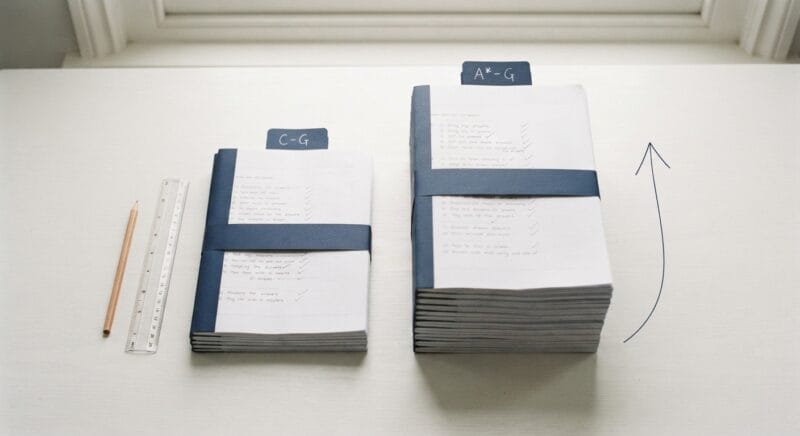
What Is the Hardest IGCSE Subject?
There’s no single universally hardest IGCSE subject — difficulty depends heavily on a student’s individual strengths, since subjects that reward mathematical fluency (like Physics) feel hardest to some students, while subjects that reward memorisation and precise written expression (like Biology or Humanities) feel hardest to others. What consistently predicts struggle more than the subject itself is revision method — students using passive review tend to find every subject harder than students using active, retrieval-based revision.
For Malaysian students and parents comparing subject difficulty, it’s worth being cautious of confident online rankings claiming one definitive “hardest” subject. Aura Tycoon’s guidance for parents covers more of these decision points too. Once tier and combination decisions are settled, understanding Core vs Extended papers often matters more for a specific student’s experience than the subject label itself.
Why Do Different Students Find Different Subjects Hard?
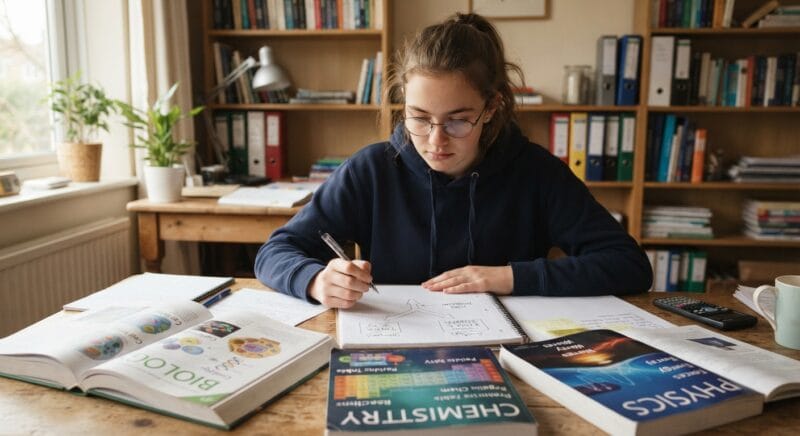
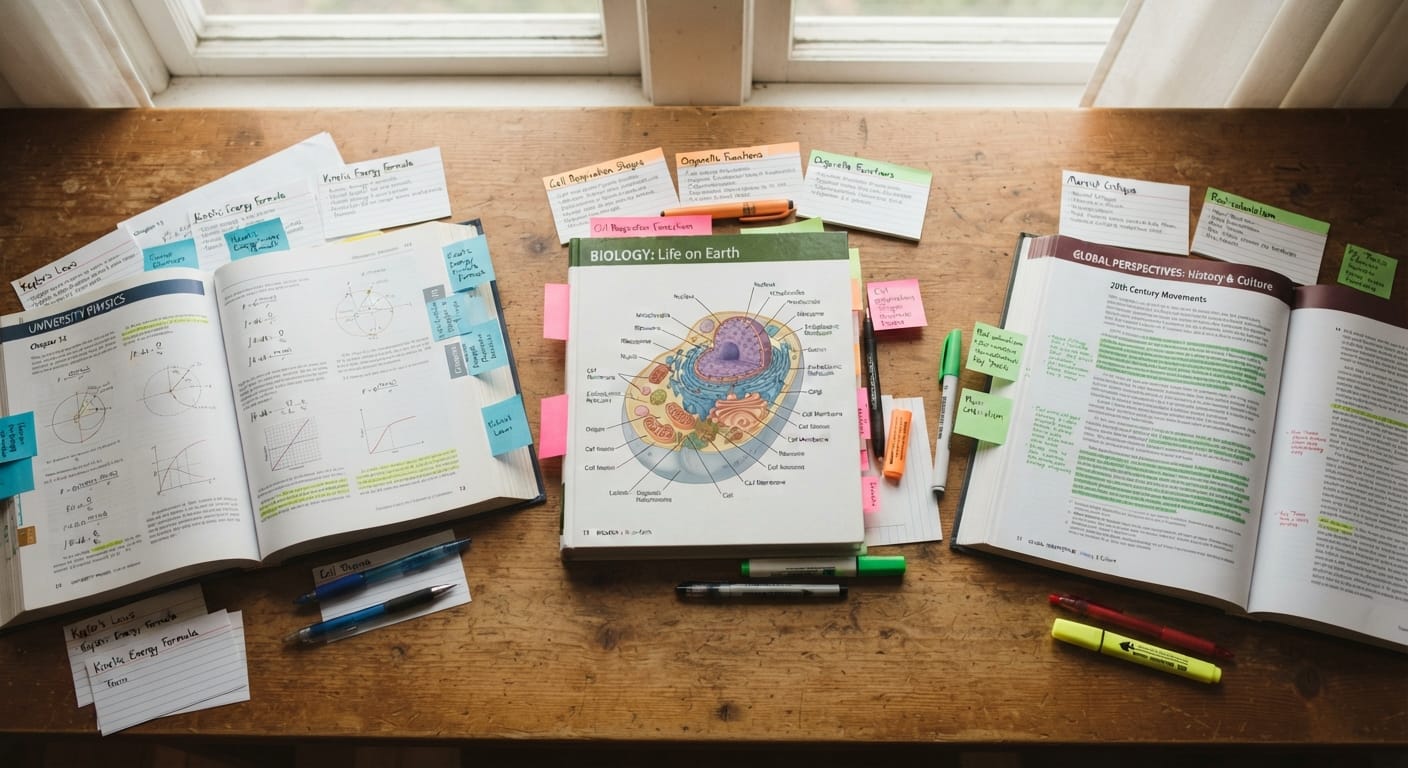
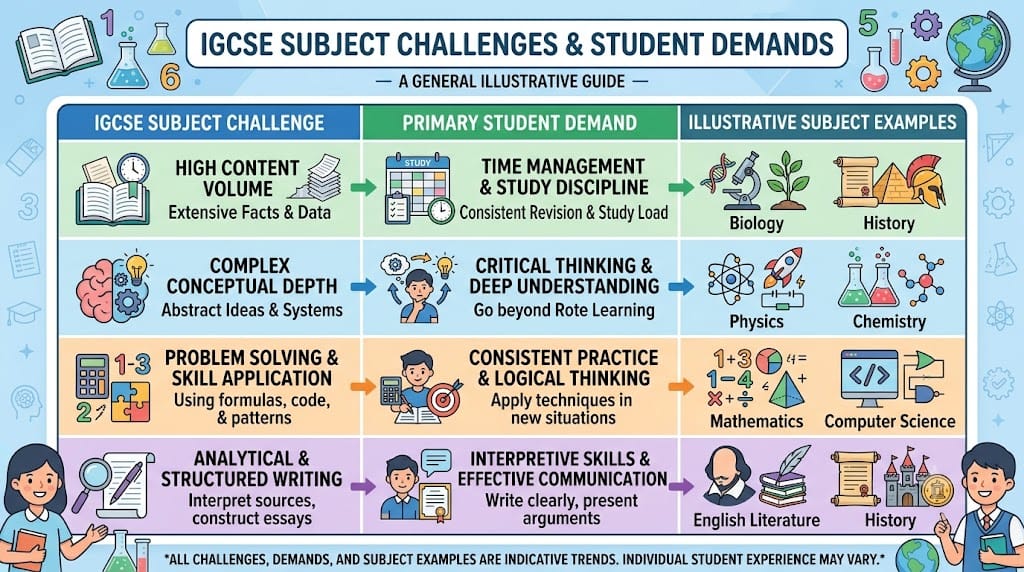
Subjects place different demands on a learner — Physics leans on mathematical calculation and abstract reasoning, Biology leans on structured memorisation and precise scientific vocabulary, and Chemistry sits between the two, requiring both calculation and recall. A student strong in Mathematics may find Physics manageable but struggle with Biology’s volume of recall, while the reverse is just as common for a different student.
Does Revision Method Matter More Than Subject Choice?
Genuinely, yes — reviews of effective study strategies consistently find that active, retrieval-based techniques outperform passive review across virtually every subject type, according to a major review of learning techniques from cognitive and educational psychology. A student using strong revision habits in a “hard” subject often outperforms a student using weak habits in an “easy” one — which subject feels hardest often says as much about study approach as about the subject itself.
What Actually Makes a Subject Feel Harder for Most Students?
A few genuine patterns show up across many students, even without there being one universal “hardest” subject:
- Content volume — subjects with large amounts of material to memorise, like Biology, can feel overwhelming without a system for tracking what’s actually been learned
- Calculation-heavy content — Physics and Chemistry’s mathematical elements catch out students less confident with maths
- Precise written expression — Humanities and English subjects reward exact wording that some students find harder to produce under time pressure than others
What Should Students Actually Do With This Information?
Rather than choosing subjects based on rumoured difficulty rankings, it’s more useful to identify genuine personal strengths and interests, then apply strong revision habits consistently across whatever subjects are chosen. A subject that feels hard in Year 10 often becomes manageable once active recall, spaced repetition, and regular past-paper practice replace passive re-reading.
Free practice tool
Aura Tycoon is a completely free, ad-free learning platform for Cambridge-track students, with chapter videos, quizzes, flashcards, and practice questions built into every topic. It offers free Year 7 Biology, Chemistry and Physics practice with every wrong answer logged by topic, well before IGCSE difficulty becomes a real concern.
Start Practicing FreeFrequently Asked Questions About IGCSE Subject Difficulty
Is Physics really the hardest IGCSE Science?
Not universally — Physics is harder for students less comfortable with mathematical calculation, but Biology's volume of recall content can feel just as hard to students who struggle with memorisation. It genuinely depends on individual strengths.
Does taking a "harder" subject look better to universities?
Universities generally value strong grades over subject difficulty rankings, though specific competitive courses may expect certain subjects regardless of perceived difficulty. Achieving a strong grade in a well-suited subject usually serves a student better than struggling in one chosen purely for reputation.
Can revision technique really change how hard a subject feels?
Yes, genuinely — students using active recall and spaced repetition consistently report subjects feeling more manageable than students relying on passive re-reading. Revision method has a real, evidenced effect on how difficulty is experienced.
Is Mathematics considered harder than the Sciences at IGCSE?
This varies by student — some find Mathematics's cumulative, skill-building nature harder than Science's mix of content and application, while others find the reverse true. Neither is universally harder across all students.
Do online "hardest IGCSE subject" rankings mean anything?
These rankings are usually based on general perception or exam pass-rate statistics, which don't account for individual strengths. They're worth reading with caution rather than treated as a reliable personal guide.
Should a student avoid a subject just because it's reputed to be hard?
Not necessarily — if a student has genuine interest or aptitude in a reputedly hard subject, avoiding it purely on reputation can close off worthwhile future pathways. A short trial period or diagnostic assessment often reveals more than a general reputation does.
Does Extended tier make a subject harder than Core tier?
Extended includes additional, more demanding content beyond Core, so in that specific sense, yes, it's more challenging. But Extended is chosen specifically for students capable of that level, so it isn't necessarily "too hard" for the right student.
Is there any subject that's hard for almost everyone?
Not really — even subjects with reputations for being universally difficult usually have students who find them manageable, often because of strong revision habits or genuine interest. Difficulty is rarely as fixed as reputation suggests.