Building a Weakness-First Revision Plan
A weakness-first revision plan gives the most time to the topics you actually get wrong, identified from real evidence like past-paper marking or a mistake log — not to whichever topics feel most familiar or comfortable to revise. It flips the usual instinct to spend more time on subjects you already enjoy, and redirects that time to where it produces the biggest improvement.
For Cambridge and IGCSE-track students in Malaysia, this matters because Science content builds across years, and an unresolved weak topic from Year 8 can quietly resurface in an IGCSE paper years later. The plan works best when weaknesses are tracked automatically rather than remembered from memory — which is exactly what a permanent Weakness Log by subject and chapter is built to do.

How Do You Identify Genuine Weak Topics?
Real weaknesses come from evidence, not impressions:
- Past-paper marking — topics that lose marks repeatedly across attempts.
- Blurting or recall checks — topics you can’t reproduce from memory.
- A running mistake log — questions marked wrong, tagged by chapter, over time.
- Teacher or tuition feedback — patterns a teacher has already flagged.
Combining more than one source gives a more reliable picture than relying on a single test.
How Should You Weight a Timetable Toward Weak Topics?
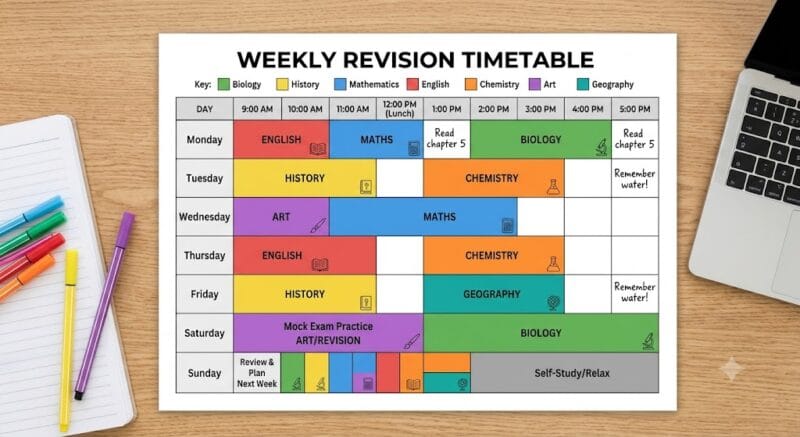
Once weak topics are identified, give them more revision slots than strong ones — not by an arbitrary amount, but roughly in proportion to how far behind they are. A topic that’s mostly secure needs only occasional spaced revisits; a genuinely weak one needs several sessions across multiple weeks. For the mechanics of building that schedule, see how to build a revision timetable.
Why Is Weighting by Weakness More Effective Than Equal Time?
Equal time across every topic wastes revision on material already understood while leaving genuine gaps unresolved. Effective study strategies consistently favour targeted, retrieval-based revision over broad passive coverage, according to a major review of learning techniques from cognitive and educational psychology — and weighting by weakness is simply that principle turned into a scheduling decision rather than a study-method choice.

When Is a Weak Topic “Mastered”?
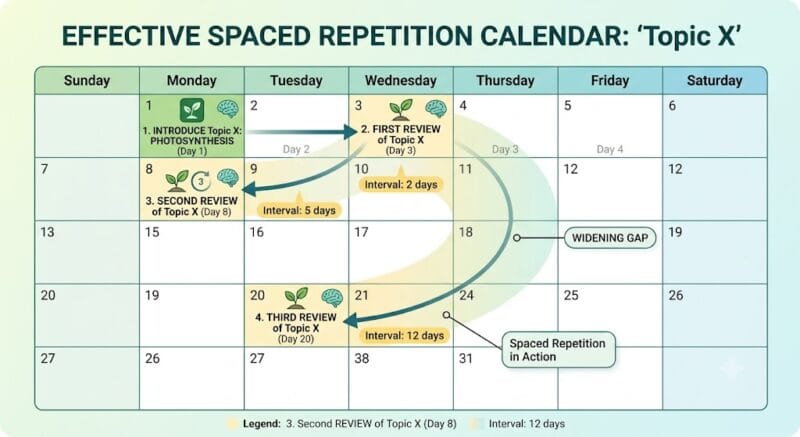
A topic is genuinely mastered when it can be recalled correctly from memory more than once, with a gap in between — not after getting it right a single time. Because a single correct answer can be luck or short-term memory rather than real understanding, it’s worth checking a topic again a few days later before marking it done. Aura Tycoon’s Weakness Log follows exactly this principle, keeping a topic flagged until it’s been correctly answered after having been previously wrong, rather than clearing it the moment it’s right once.
Free practice tool
Aura Tycoon is a free learning platform for Cambridge-track students — each chapter combines teaching videos, quizzes, and flashcards with practice questions, all with no ads and no cost. It builds the weakness data this plan depends on automatically — every wrong answer across Year 7 Biology, Chemistry and Physics is logged by topic, for free, so the plan can be built on evidence from day one.
Start Practicing FreeFrequently Asked Questions About Weakness-First Revision Plans
What does "weakness-first" mean in revision planning?
It means giving the most revision time to topics you demonstrably get wrong, rather than to subjects that simply feel comfortable. Evidence — from past papers or a mistake log — drives the plan, not impressions.
How do I find my weak topics without a tracking tool?
Mark past papers by topic rather than just an overall score, and keep a simple written log of which questions you get wrong and when. It takes more manual effort, but the principle is the same.
Isn't it better to spend more time on my worst subject overall?
Not quite — weakness often varies topic by topic within a subject a student otherwise finds manageable. A weakness-first plan targets specific topics, not just whole subjects.
How often should a weakness-first plan be updated?
Regularly — as topics get mastered and new gaps appear through ongoing practice, the plan should shift with the evidence. A plan made once months ago won't reflect current weak points.
Does a weakness-first approach work for all three Sciences?
Yes, it applies equally to Biology, Chemistry and Physics, since each has its own set of topics that can be individually weak or strong. Tracking by subject and chapter, rather than a single Science score, gives the clearest picture.
What if almost everything feels weak?
Start with the topics closest to being tested next, or the ones flagged most often in past-paper marking, rather than trying to fix everything at once. A weakness-first plan still needs to be realistic about time available.
How is this different from just doing more past papers?
Past papers are one of the best sources of evidence for a weakness-first plan, but the plan itself is about deliberately allocating time based on that evidence. Doing papers without adjusting the following revision misses the point.
Can a weakness-first plan help with Cambridge Checkpoint too?
Yes, Checkpoint's own topic-level feedback report is essentially a ready-made weakness list, well suited to exactly this kind of plan. Building the habit before Year 9 makes the same approach easier to apply again for IGCSE.