How IGCSE Affects A Level and University Choices
IGCSE results and subject choices affect A Level and university options in two ways: grades determine which A Level subjects a student is likely to be accepted into, and the specific IGCSE subjects taken (or not taken) can open or close entire A Level and degree pathways later. This second effect catches families off guard most often — a student who didn’t take Separate Sciences at IGCSE may find certain A Level Science subjects, and by extension certain competitive degree courses, harder to access.
For Malaysian families planning several years ahead, understanding this link early avoids painful surprises in Year 11. Aura Tycoon’s guidance for parents covers more of these long-range planning questions. This connects directly to why Separate Sciences matter specifically for Medicine and Engineering pathways, one of the clearest examples of this effect in practice.
How Do IGCSE Grades Affect A Level Entry?
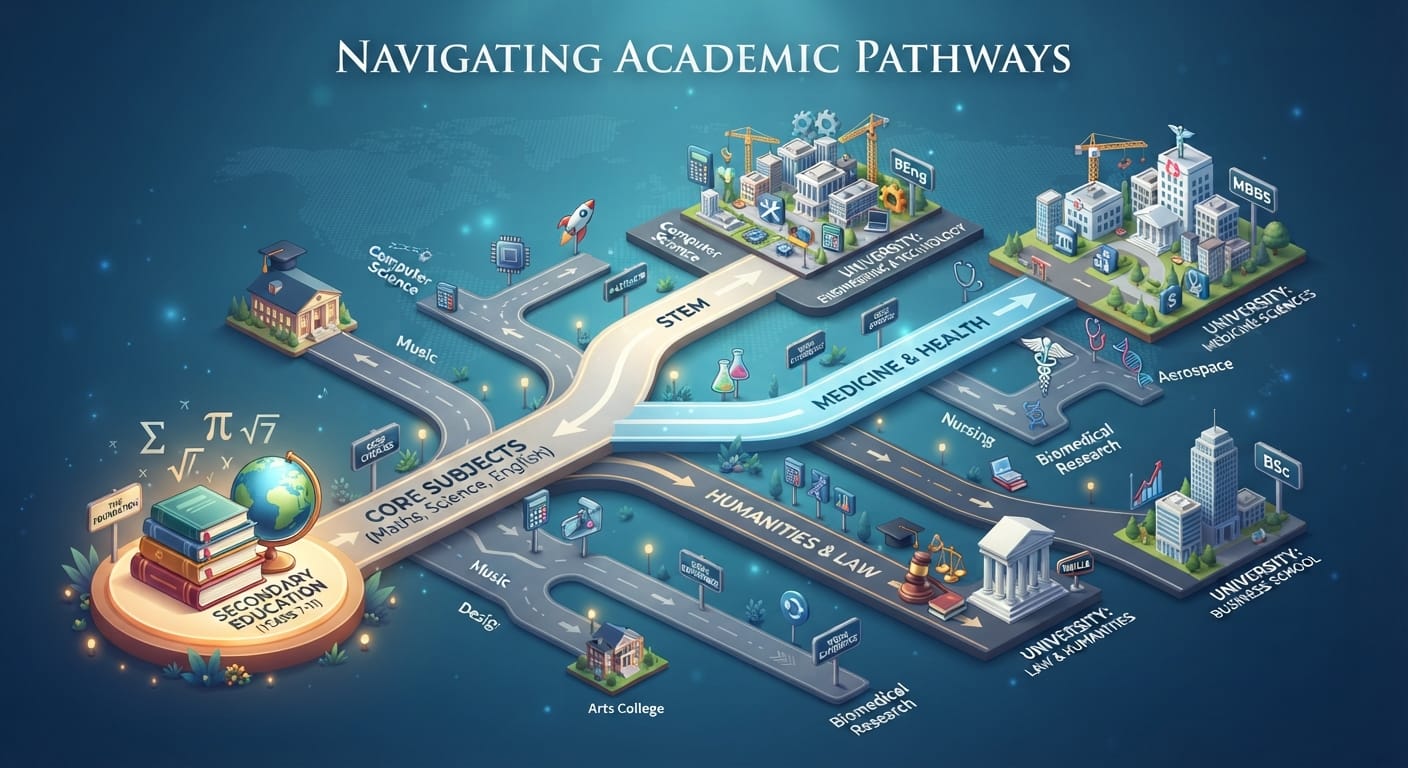
Most schools set minimum IGCSE grade requirements for entry into specific A Level subjects — commonly a B or above in the relevant IGCSE subject for that A Level to be offered. A student with a C in IGCSE Mathematics, for example, may be steered away from A Level Mathematics at some schools, even if they’re otherwise strong students, since the school judges the foundation isn’t secure enough for the jump in difficulty.
How Do IGCSE Subject Choices Affect University Applications?
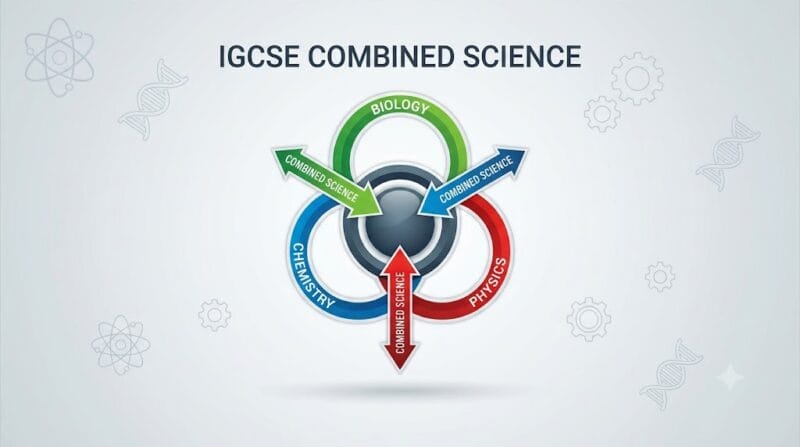
Beyond grades, the specific subjects taken at IGCSE matter for certain competitive degree pathways — Medicine typically expects Separate Science IGCSEs (or at minimum separate Biology and Chemistry), and Engineering programmes usually expect strong Mathematics and Physics results specifically, not just a general Combined Science pass. Cambridge itself offers more than 70 IGCSE subjects for schools to combine, according to Cambridge International’s own subject listing, which is exactly why deliberate subject selection matters more than simply taking whatever’s offered by default. A student without these specific subjects on their IGCSE record may need to take them privately later, adding cost and complexity that could have been avoided with earlier planning.
Does This Mean Every Student Needs to Plan for Medicine or Engineering at IGCSE?
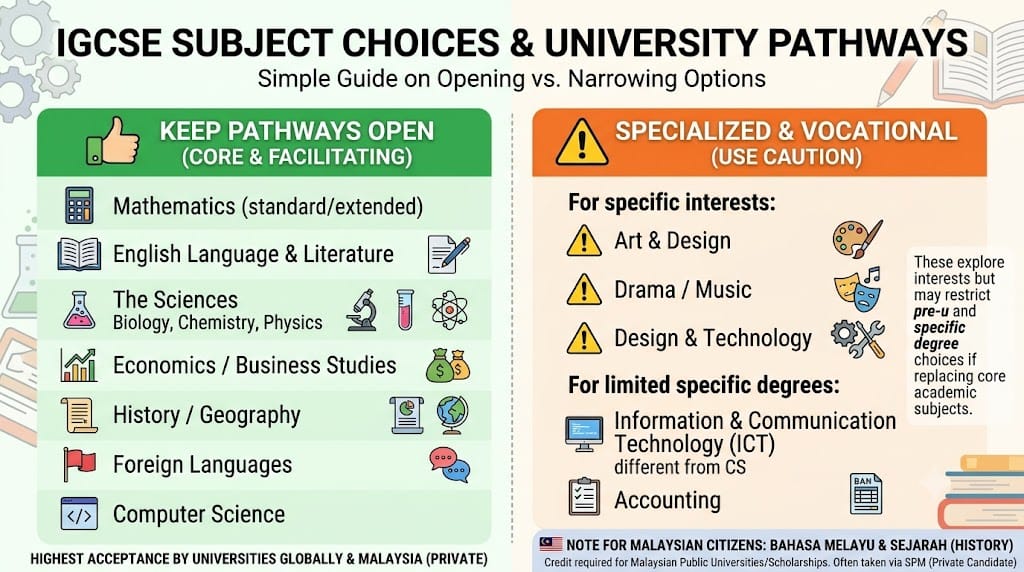
No — most students haven’t settled on a specific degree path by the time IGCSE subjects are chosen, and that’s completely normal. The practical takeaway isn’t “commit to a career at 14,” but rather “keep options open where reasonably possible,” particularly around Separate Sciences and Mathematics, since those are the subjects most likely to close doors if skipped.
What Should Families Do If University Plans Are Still Unclear?
Favour subject combinations that preserve flexibility — Separate or Co-ordinated Sciences over Combined Science where workload allows, and Mathematics at the strongest tier a student can genuinely manage — rather than trying to predict a specific future career this early. Revisiting the plan at the start of A Level, once interests are clearer, is normal and expected.
Free practice tool
Aura Tycoon is a free, ad-free learning platform for Cambridge-track students, pairing short chapter videos, quizzes, and flashcards with practice questions and quick games. It offers free Year 7 Biology, Chemistry and Physics practice with every wrong answer logged by topic.
Start Practicing FreeFrequently Asked Questions About IGCSE's Effect on A Level and University
Do universities look at IGCSE results directly?
Yes, many universities do consider IGCSE grades as part of a full application, particularly for competitive courses, alongside predicted and actual A Level grades. IGCSE results also determine which A Level subjects a student can access in the first place.
What IGCSE grade is usually needed to take an A Level in the same subject?
This varies by school, but a B or above in the related IGCSE subject is a common minimum expectation. Some schools set higher bars for particularly demanding A Level subjects like Mathematics or the Sciences.
Can a student take an A Level subject they didn't study at IGCSE?
Sometimes, particularly for genuinely new subjects like Economics or Psychology that aren't commonly offered at IGCSE, but this is much harder for subjects that build directly on IGCSE content, like the Sciences or Mathematics. Schools vary in how flexible they are about this.
Does Combined Science limit A Level Science options?
It can — students who took Combined Science and then choose separate Science A Levels may find themselves with content gaps compared to peers who took Separate Sciences at IGCSE. This doesn't make it impossible, just potentially harder.
How early should university plans influence IGCSE subject choices?
Early enough to keep flexible options open — generally by the start of Year 10, when subjects are chosen — without needing to commit to a specific career path this soon. Favouring flexible subjects is more realistic than predicting an exact future degree.
Do all universities require the same IGCSE subjects for the same degree?
No, requirements vary meaningfully between universities and even between specific courses at the same university. Checking individual programme requirements directly is more reliable than assuming a universal standard.
Is it possible to add missing IGCSE subjects later as a private candidate?
Yes, this is a genuine option for students who discover a gap in their subject choices, though it adds cost and time compared to having taken the subject the first time. It's a workable fallback, not an ideal starting plan.
Does taking more IGCSE subjects improve university chances?
Not directly — universities generally value strong grades in relevant, well-chosen subjects over a high total subject count. Quality and relevance of subject choice matters more than sheer quantity.