Is Cambridge Lower Secondary Science One Subject or Three?
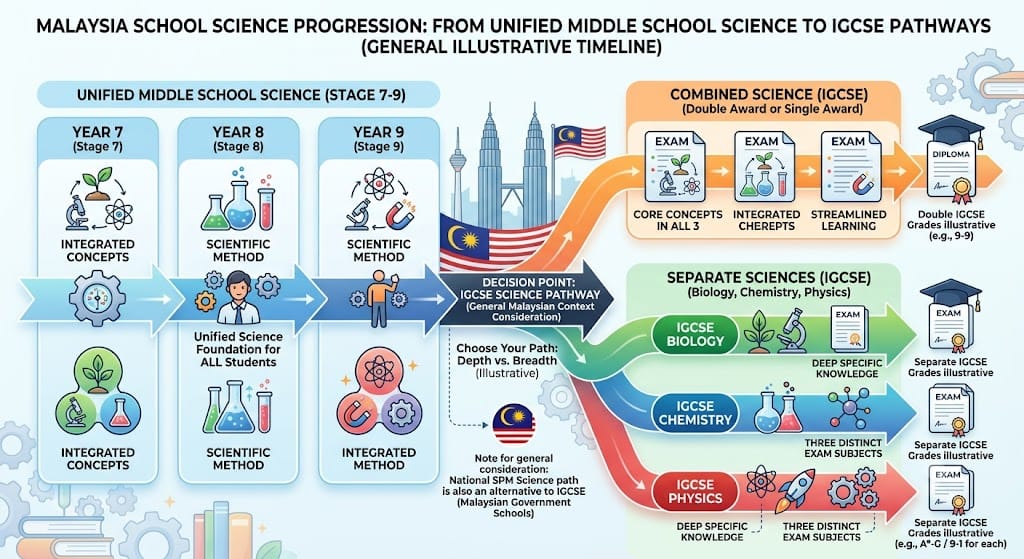
Cambridge Lower Secondary Science (Years 7 to 9) is taught and examined as one unified subject, not split into separate Biology, Chemistry and Physics — Checkpoint issues a single overall Science score, not three. The split into three separate Science subjects doesn’t happen until IGCSE, where students choose between Combined Science, Co-ordinated Science, or Separate Sciences.
For Malaysian parents used to seeing Biology, Chemistry and Physics as distinct subjects from an early age, this single-subject structure at Lower Secondary can be a genuine surprise — much like discovering Checkpoint itself isn’t compulsory at all, it’s a structural detail worth knowing early. Aura Tycoon’s Chemistry practice shows what one of those eventual strands looks like once it does split out.
Why Is Science Taught as One Subject at Lower Secondary?
Cambridge Lower Secondary is designed to build broad skills and understanding across English, Mathematics and Science as a foundation, rather than specialise students into separate scientific disciplines this early. A single unified Science subject reflects that broader, integrated approach — students learn biological, chemical and physical concepts within one connected curriculum framework rather than as three separately timetabled subjects.
Does a Single Science Score Hide Individual Strand Performance?
Not entirely — while the headline Checkpoint Science score is one number, the underlying report breaks that score down by strand, including areas like Biology, Chemistry, Physics, and Earth and Space, according to Cambridge International’s own scoring documentation. A student can appear solid overall while one specific strand sits meaningfully lower, and that strand-level detail is exactly what’s worth tracking rather than the single overall figure alone.
When Does Science Actually Split Into Separate Subjects?
The split happens at IGCSE, typically from Year 10, where students choose between:
- Combined Science — one certificate covering Biology, Chemistry and Physics content together
- Co-ordinated Science (Double Award) — similar structure, two grades awarded
- Separate Sciences — Biology, Chemistry and Physics each examined and graded individually
This means the “one subject” structure of Lower Secondary Science is genuinely temporary — by design, not by accident — and every Lower Secondary student is on a path that will eventually involve this choice.
Does the “One Subject” Structure Affect How Families Should Track Progress?
Yes — since the headline score doesn’t show strand weaknesses on its own, it’s worth looking past a single “good” overall result to check whether one strand is quietly underperforming the others. This matters most in the run-up to the IGCSE Science choice, since a strand-level weakness spotted early gives more time to address it before that decision has to be made.
Free practice tool
Aura Tycoon is a free, ad-free learning platform for Cambridge-track students, pairing short chapter videos, quizzes, and flashcards with practice questions and quick games. It already separates Year 7 practice into Biology, Chemistry and Physics individually, for free, so strand-level strengths and weaknesses are visible years before Checkpoint reports them as a single combined score.
Start Practicing FreeFrequently Asked Questions About Lower Secondary Science Structure
Is Cambridge Lower Secondary Science the same as Combined Science at IGCSE?
Not exactly — Lower Secondary Science is a single unified subject with one Checkpoint score, while Combined Science at IGCSE is a specific IGCSE option among several, including Co-ordinated and Separate Sciences. They're related stages, not the same qualification.
Why doesn't Checkpoint give separate Biology, Chemistry and Physics scores?
Because Cambridge Lower Secondary teaches Science as one integrated subject rather than three separate ones, the headline Checkpoint score reflects that same structure. Strand-level detail within the report does still break down performance by area.
Can a student tell if they're weaker in Physics than Biology from their Checkpoint report?
Yes, the strand-level breakdown within the Science report shows performance across areas like Biology, Chemistry, Physics, and Earth and Space individually. This detail is worth reviewing even when the overall subject score looks solid.
When do Malaysian Cambridge students first choose separate Sciences?
This choice typically happens when moving into IGCSE, usually at the start of Year 10, where students select Combined Science, Co-ordinated Science, or Separate Sciences. It doesn't happen during Lower Secondary itself.
Does a strong overall Science score guarantee even strength across Biology, Chemistry and Physics?
No, a strong overall score can still mask an uneven strand-level performance, since the headline figure is a combined result rather than three separate individual scores. Checking the strand breakdown is the only way to see this clearly.
Is unified Science at Lower Secondary easier than separate subjects would be?
Not necessarily easier, just structured differently — students still cover biological, chemical and physical concepts, simply within one connected subject rather than three timetabled ones. The depth of content isn't reduced by the unified structure.
Do all Cambridge schools teach Lower Secondary Science the same way?
The core curriculum framework is set by Cambridge, but individual schools have some flexibility in delivery, timetabling, and how they present strand-level feedback to students and parents. The underlying Checkpoint structure, however, is consistent across schools.
Should parents worry if their child's Lower Secondary school doesn't mention Biology, Chemistry or Physics by name?
No, this is expected at this stage — the unified Science subject naturally covers content from all three areas without necessarily labelling it that way day to day. The named split becomes relevant again once IGCSE subject choices begin.