After Checkpoint: Choosing IGCSE Subjects
Checkpoint results are most useful for IGCSE subject decisions as a strand-level guide, not a single verdict — a student’s overall Science band matters less than which specific strands (Biology, Chemistry, Physics) came out strongest, since that pattern can inform whether Separate or Combined Sciences suits them better at IGCSE. Checkpoint isn’t a formal prerequisite for any IGCSE subject, but it’s genuinely useful evidence when the choice isn’t obvious.
For Malaysian families approaching this decision, it’s worth remembering that Checkpoint scores are diagnostic, not a final verdict, so strand-level weaknesses are as much a revision target now as a subject-choice signal later. Aura Tycoon’s parent guidance also covers more of the decisions that come up around this stage.

How Should a Family Read Checkpoint Results Before Choosing IGCSE Subjects?
Look past the single overall band to the strand-level breakdown within each subject — a student can be “Good” overall in Science while genuinely strong in Biology and comparatively weak in Physics, and that detail matters more for subject choice than the headline score. The same applies within Mathematics and English, where strand performance can point toward strengths worth building on or gaps worth addressing before IGCSE begins.
What Does a Checkpoint Band Suggest About Likely IGCSE Performance?
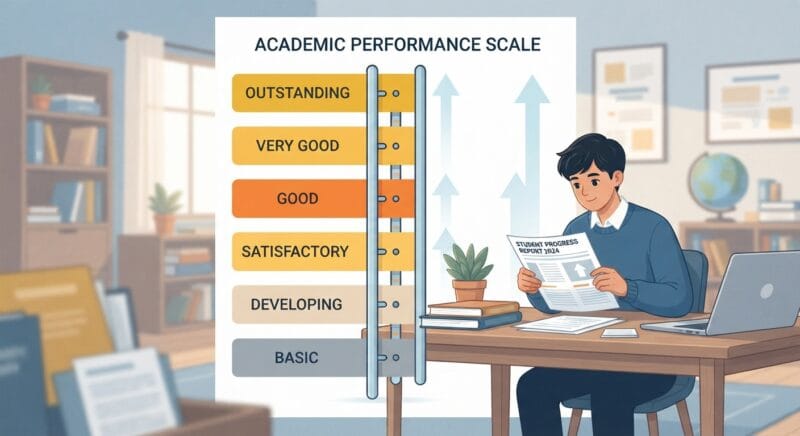
Cambridge has published a rough average-level expectation: a “Good” Checkpoint band typically aligns with roughly a C/4 IGCSE standard, and an “Outstanding” band with roughly an A/7 standard, according to Cambridge International’s own reporting guidance. This is described as an average across all learners, not a fixed prediction for any individual student, so it’s a useful reference point rather than a ceiling or a guarantee.
Does Checkpoint Science Help Decide Between Combined and Separate Sciences?
It can — a student who performs unevenly across Biology, Chemistry and Physics strands at Checkpoint may be better suited to Separate Sciences at IGCSE, where each subject is graded individually rather than combined into one overall Science result. A student with more even performance across all three strands may find Combined Science a comfortable, lower-workload option that still keeps Science pathways open.

What Other Factors Matter Beyond Checkpoint Results?
Checkpoint is one input among several — a student’s genuine interest in a subject, the school’s own subject offerings, and future university or career plans (particularly for Separate Sciences, often expected for medicine or engineering) all matter alongside the Checkpoint evidence. Checkpoint results should inform the conversation, not replace it entirely.
Free practice tool
Aura Tycoon is a free, ad-free learning platform for Cambridge-track students, pairing short chapter videos, quizzes, and flashcards with practice questions and quick games. It gives an early, ongoing picture of the same kind of strand-level strength and weakness — free Year 7 Biology, Chemistry and Physics practice with every mistake logged by topic.
Start Practicing FreeFrequently Asked Questions About IGCSE Subject Choice After Checkpoint
Does a Checkpoint Science score decide whether a student takes Combined or Separate Sciences?
Not on its own — it's useful evidence, particularly the strand-level breakdown, but the final decision usually also involves school offerings, student interest, and future study plans. Checkpoint results inform the choice rather than making it automatically.
Is Checkpoint required to enrol in any specific IGCSE subject?
No, Checkpoint isn't a formal prerequisite for IGCSE subjects — students can take any IGCSE subject their school offers regardless of Checkpoint participation or results. It functions as diagnostic guidance, not a gatekeeping requirement.
What if a student's Checkpoint English score is weaker than their Science score?
This is useful information for planning extra support in English before IGCSE begins, rather than a reason to avoid English-heavy subjects entirely. Strand-level detail within the English report can show exactly which skills need the most attention.
Should a strong Checkpoint Science result lead to taking Triple Science at IGCSE?
It can be a positive signal, especially if strong performance is fairly even across Biology, Chemistry and Physics strands, but it shouldn't be the only factor. Workload capacity and future subject requirements for university courses matter too.
How reliable is Checkpoint as a predictor of IGCSE grades?
It's a genuine average-level guide, not an exact prediction — Cambridge describes the Checkpoint-to-IGCSE relationship as an average across all learners, with real variation between individual students. Two years of further study can shift outcomes meaningfully in either direction.
Can IGCSE subject choices be changed after they're first selected?
This depends on the specific school's policies and how far into the course a student is, since changing subjects becomes harder once significant content has been covered. Raising concerns with the school as early as possible gives the most flexibility.
Does a weak Checkpoint result in one Science strand mean that subject should be avoided at IGCSE?
Not necessarily — a weak strand at Checkpoint is more useful as a signal for where to focus extra support before IGCSE begins than as a reason to avoid the subject altogether. Two years is enough time to close a specific strand gap with targeted revision.
Who should be involved in the after-Checkpoint subject choice conversation?
Ideally the student, parents, and the school's subject teachers or counsellor, since each brings a different useful perspective — academic evidence from Checkpoint, personal interest from the student, and practical constraints from the school. A decision made with all three in mind tends to hold up better than one made in isolation.