
Cambridge Checkpoint Scoring Explained
Cambridge Checkpoint scores are reported on a 0 to 50 scale, grouped into six performance bands from Unclassified up to Outstanding, and calculated using a statistical method called Rasch analysis rather than a simple percentage. This means a Checkpoint score doesn’t map onto a raw percentage the way a normal classroom test might.
For Malaysian parents seeing a Checkpoint report for the first time, the scoring can look unfamiliar. Understanding the scale matters most once it feeds into a real decision, like choosing IGCSE subjects once Checkpoint results are in. Since Checkpoint Science strands map onto the separate sciences students meet later, it’s worth browsing Aura Tycoon’s Physics practice to see what that strand-level content looks like in practice.
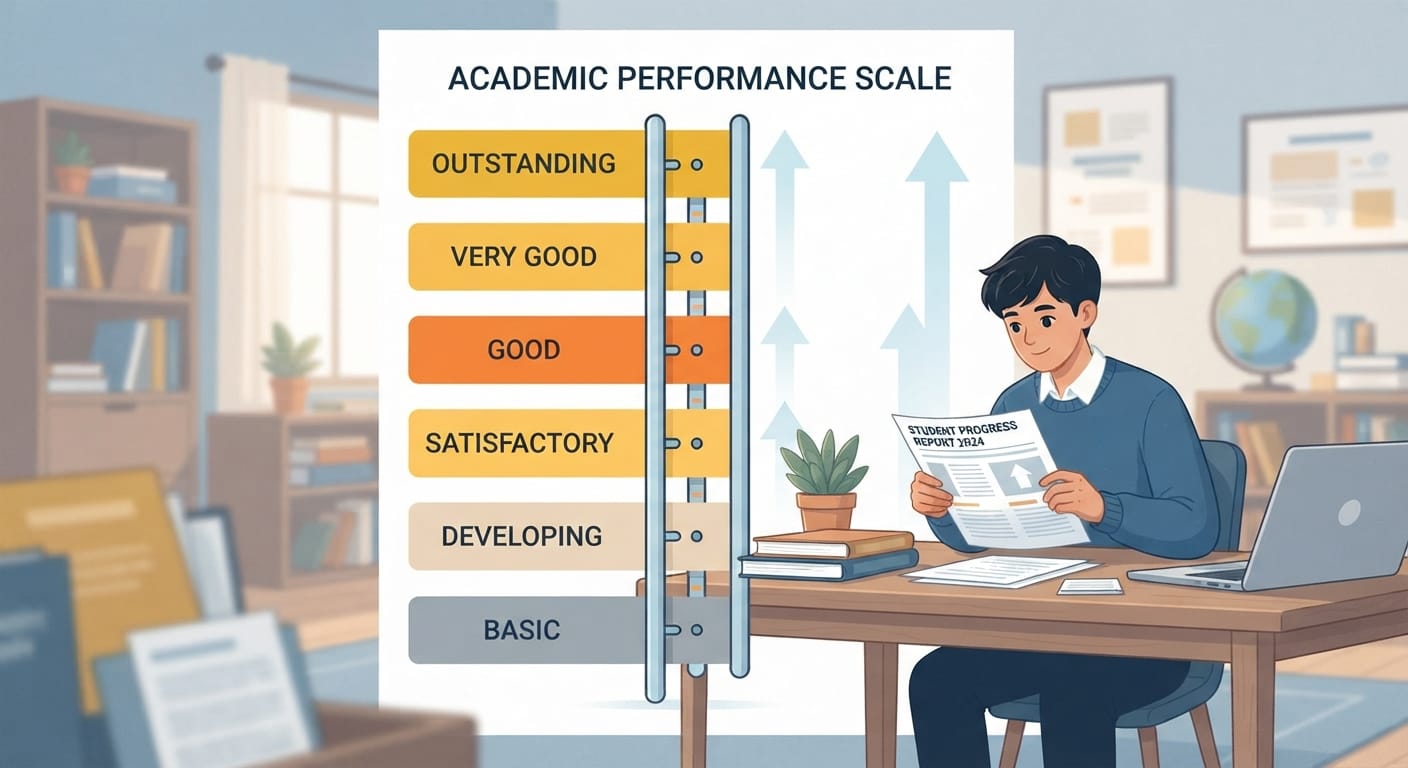
What Are the Six Checkpoint Performance Bands?
The current bands, in effect since May 2023, run as follows:
| 0 | Unclassified |
| 1–10 | Basic |
| 11–20 | Aspiring |
| 21–30 | Good |
| 31–40 | High |
| 41–50 | Outstanding |
This replaced an older, differently worded system, so a Checkpoint report from before 2023 uses different terminology entirely, according to Cambridge International’s own performance band FAQ.
Why Isn’t a Checkpoint Score a Simple Percentage?
Checkpoint scores are calculated using Rasch analysis, a statistical technique that accounts for how difficult each specific question was, rather than just counting marks. This means the same 0 to 50 score represents a similar level of understanding across different subjects and different exam sessions, even though the raw marks needed to reach that score can vary. A given number of extra raw marks doesn’t always move the Checkpoint score by the same amount.
How Does a Checkpoint Score Relate to Future IGCSE Grades?
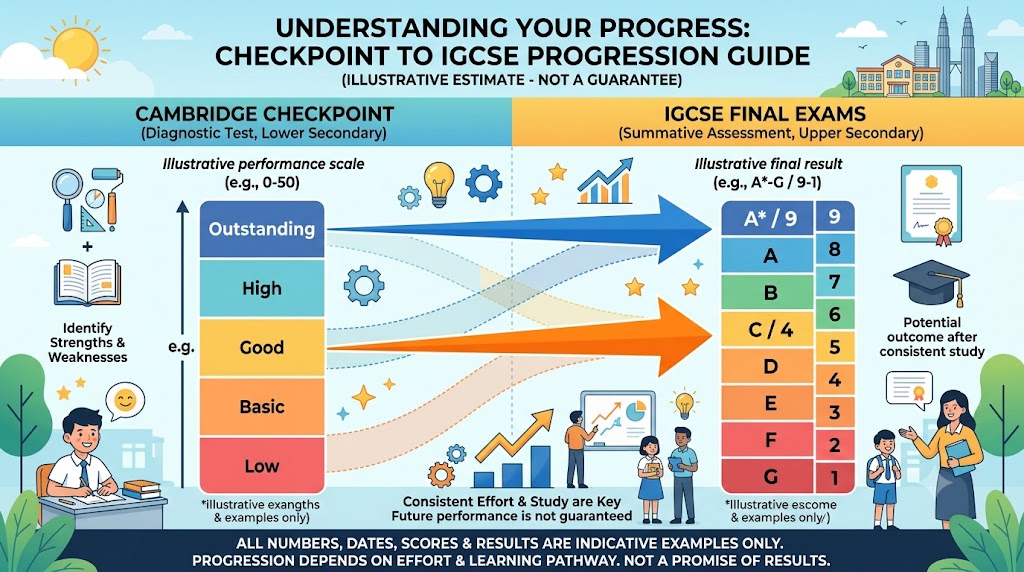
Cambridge has published a rough, average-level expectation: students who achieve a “Good” performance band at Checkpoint would typically go on to achieve around a C/4 standard at IGCSE, while an “Outstanding” band would typically align with an A/7 standard. This is described as an average across all learners, not a guarantee for any individual student — some students progress faster than this pattern suggests, and some slower.
What Should Parents Take Away From a Checkpoint Score?
A Checkpoint score is most useful as a topic-level diagnostic rather than a single overall verdict — the strand-by-strand breakdown within each subject usually matters more for planning revision than the headline band alone. A student can be “Good” overall in Science while a specific strand, like Physics, sits noticeably lower, and that’s the detail worth acting on.
Free practice tool
Aura Tycoon is a free learning platform for Cambridge-track students — each chapter combines teaching videos, quizzes, and flashcards with practice questions, all with no ads and no cost. It tracks exactly this kind of topic-level detail for free, years before Checkpoint — every wrong answer in Year 7 Biology, Chemistry and Physics is logged so a strand-level weak spot doesn’t stay hidden until Year 9.
Start Practicing FreeFrequently Asked Questions About Checkpoint Scoring
What is a good Cambridge Checkpoint score?
A score in the "Good" band (21–30) or higher is generally considered a solid result, with "High" (31–40) and "Outstanding" (41–50) representing stronger performance. What counts as "good enough" depends on a family's specific goals for IGCSE.
How is a Checkpoint score different from a percentage?
A Checkpoint score is calculated using Rasch analysis, which accounts for question difficulty, so it isn't a direct percentage of marks achieved. Two students with different raw marks in different sessions can end up with a similar, comparable Checkpoint score.
Does a Checkpoint score predict IGCSE grades exactly?
No, it gives an average-level expectation, not an individual guarantee — a "Good" band roughly aligns with a C/4 IGCSE standard and "Outstanding" with A/7, but individual progress varies. Two years of further study separate Checkpoint from IGCSE.
Why did Cambridge change the Checkpoint scoring system?
Cambridge introduced the new 0–50 scale and six performance bands in 2023 to align Checkpoint reporting with Progression Test reporting, since schools found the old separate systems confusing. The change also made scores more directly comparable across subjects.
What does "Unclassified" mean on a Checkpoint report?
Unclassified is the band below Basic, corresponding to a score of 0, indicating the learner did not demonstrate the minimum level of skill and understanding measured by the test. It's rare and usually prompts a closer look at what happened during that specific sitting.
Are Checkpoint scores comparable across English, Maths and Science?
Yes, part of the purpose of the 0–50 scale is to make a given score represent a similar level of performance across different subjects. This lets schools compare a student's relative strengths across subjects more meaningfully than the old scale allowed.
Do all Checkpoint subjects use the same scoring scale?
The four main subjects — English, English as a Second Language, Mathematics and Science — use the 0–50 scale and six bands. Global Perspectives Checkpoint is scored differently, using coursework marked out of 40 with Gold, Silver and Bronze bands.
Can a Checkpoint score go down between Year 7 and Year 9 if a student doesn't improve?
Checkpoint itself is only sat once, typically at the end of Year 9, so there isn't a Year 7 Checkpoint score to compare against directly. Schools sometimes use earlier Progression Tests, scored on the same aligned scale, to track trends before Checkpoint itself.