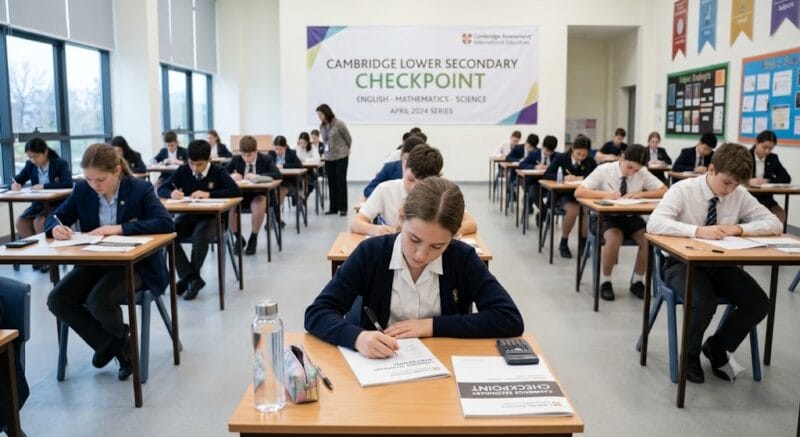
What Is Cambridge Lower Secondary Checkpoint?
Cambridge Lower Secondary Checkpoint is a set of diagnostic tests, usually sat at the end of Year 9, that shows how a student’s English, Mathematics and Science understanding compares against an international benchmark before IGCSE begins. It is not a pass/fail exam, and in Malaysia it carries no weight toward SPM or IGCSE itself — instead, it produces a detailed feedback report showing which specific topics a student has mastered and which still need work.
For Malaysian parents whose children are on the Cambridge pathway, Checkpoint is usually the first real external benchmark since Cambridge Primary. For a broader look at how this fits the school choices ahead, see Aura Tycoon’s guidance for parents. Once Checkpoint results are in, understanding exactly how those scores are calculated is usually the next practical question.

Which Subjects Does Cambridge Checkpoint Cover?
Cambridge Lower Secondary Checkpoint covers four subject areas: English (First Language), English as a Second Language, Mathematics, and Science. A separate, differently structured assessment — Global Perspectives Checkpoint — exists as a coursework-based research report marked by the school and moderated by Cambridge, rather than a written exam.
- Each of the four main subjects has two question papers
- All papers except Global Perspectives are marked directly by Cambridge International, not by the school
- Science is tested as one unified subject, not split into Biology, Chemistry and Physics at this stage
This is what makes Checkpoint useful as a genuine external benchmark — the marking standard is the same one used for Cambridge schools worldwide.
How Is Cambridge Checkpoint Scored?
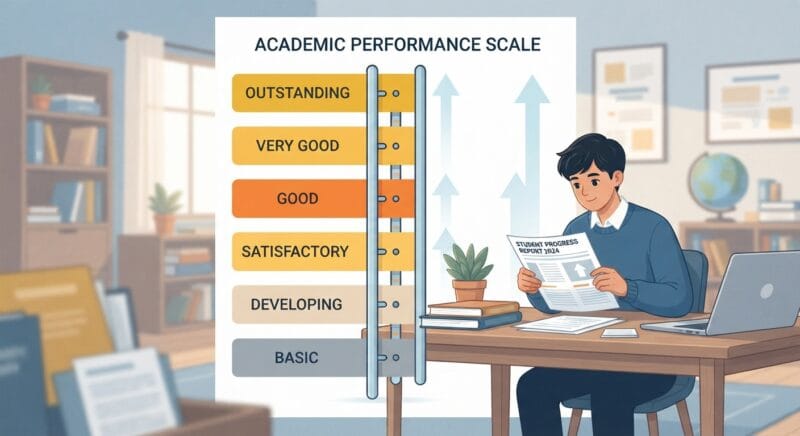
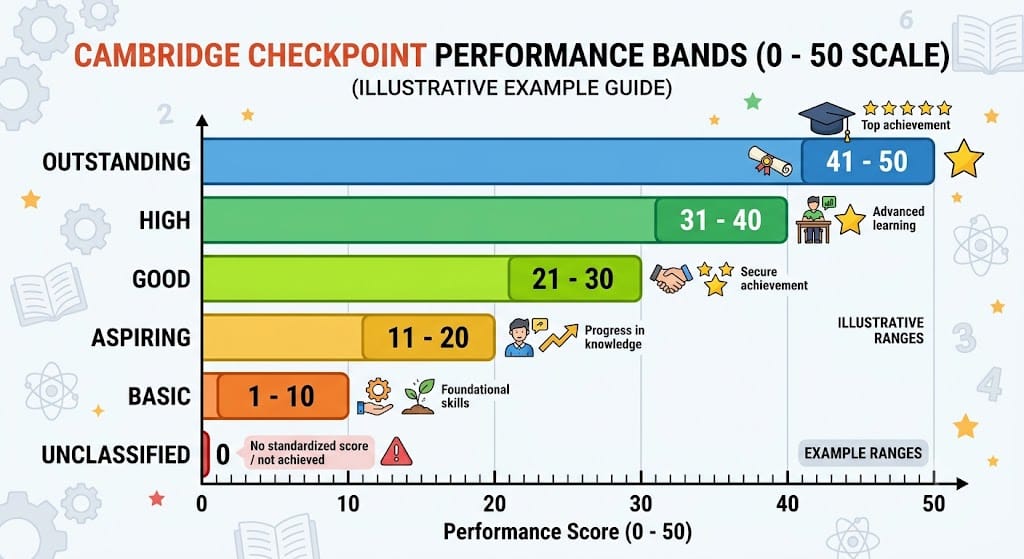
Since May 2023, Cambridge Checkpoint scores are reported on a 0 to 50 scale, replacing the older 0.0–6.0 scale, and grouped into six performance bands: Unclassified, Basic, Aspiring, Good, High and Outstanding, according to Cambridge International’s own reporting FAQ. The report also breaks each subject down by strand — so a student might score well overall in Science but have a specific weak strand, like Physics or Earth and Space, flagged separately.
Is Cambridge Checkpoint Compulsory in Malaysia?
No — Checkpoint is optional, and whether a school enters its students depends on individual school policy, not a Ministry of Education or Cambridge requirement. One detail worth knowing: Checkpoint is not open to private candidates, according to Cambridge’s own official guidance. (Note: some Malaysian exam centres advertise “Checkpoint” registration for private candidates — this appears to conflict with Cambridge’s published policy, so it’s worth verifying directly with Cambridge or the school before relying on it.) Whether it’s compulsory at a specific school is ultimately a school-level policy decision, not a Cambridge-wide rule.
Free practice tool
Aura Tycoon is a completely free, ad-free learning platform for Cambridge-track students, with chapter videos, quizzes, flashcards, and practice questions built into every topic. It lets them practise Biology, Chemistry and Physics for free, with every wrong answer automatically logged by topic — so the pattern of what needs work is visible well before Checkpoint day.
Start Practicing FreeFrequently Asked Questions About Cambridge Checkpoint
What age do students sit Cambridge Checkpoint in Malaysia?
Students typically sit Cambridge Lower Secondary Checkpoint at the end of Year 9, around age 14, aligning with the final year of the three-year Cambridge Lower Secondary programme. Some schools may adjust timing slightly based on their own academic calendar.
Does Checkpoint affect a student's IGCSE grade?
No, Checkpoint results have no direct effect on IGCSE grades, functioning purely as a diagnostic benchmark. Schools sometimes use the results informally to forecast likely IGCSE performance and guide subject-level support.
Can homeschooled students in Malaysia take Cambridge Checkpoint?
No, Cambridge does not permit private or homeschooled candidates to sit Checkpoint, since the feedback depends on being part of a registered teaching group. Homeschooling families following the Cambridge pathway independently should rely on structured mock papers for Year 9 benchmarking instead.
How much does it cost to sit Cambridge Checkpoint in Malaysia?
Cost isn't published as a fixed universal fee, since Checkpoint is arranged and paid for through the student's own registered school rather than sat externally. Parents should check directly with their child's school for the fee included in that term's assessment costs.
What's the difference between Cambridge Checkpoint and SPM?
Checkpoint is a diagnostic, non-qualifying assessment for Years 7 to 9 under the Cambridge curriculum, while SPM is Malaysia's national school-leaving exam sat in Form 5 under a completely separate national syllabus. Students on the Cambridge pathway generally don't sit SPM, since Checkpoint leads toward IGCSE rather than the Malaysian national system.
Is a low Checkpoint score something to worry about?
A lower Checkpoint band signals which topics need focused revision, not a fixed prediction of IGCSE failure, since the two years between Checkpoint and IGCSE leave plenty of room to close identified gaps. The topic-level breakdown in the report is specifically designed to make that targeted revision possible.
What subjects does Checkpoint NOT cover?
Checkpoint does not test Humanities, Art and Design, Music, Physical Education, or Digital Literacy, since it's limited to English, Mathematics, Science and, separately, Global Perspectives. Schools may assess those other subjects through their own internal methods.
When during the year does Checkpoint take place?
Cambridge Lower Secondary Checkpoint is offered in two windows each year, with the exact date set by each school within those periods. Malaysian schools typically confirm the specific sitting date at the start of the academic term.